A used car battery is hazardous waste and must not go in a household bin or be left beside one. In Dubai, the transport and recycling of used lead-acid batteries is regulated by Dubai Municipality under Circular No. 3 of 2018, and federally by Law No. 12 of 2018 on Integrated Waste Management. The simplest route is to let the technician who fits the new battery take the old one away for licensed recycling.
Why a car battery is hazardous waste
A car battery is mostly lead and sulphuric acid. Lead is a toxic heavy metal that does not break down, and the acid is corrosive enough to burn skin and damage concrete. That is true of flooded, EFB and AGM batteries alike.
A battery that looks dead is still dangerous. It holds acid, it can still deliver a heavy current if the terminals are shorted, and a cracked case leaks. Handled properly, though, it is one of the most recyclable products on a car.
What the rules say
Used lead-acid batteries are regulated waste in the UAE. In Dubai, Dubai Municipality regulates their transport and recycling under Circular No. 3 of 2018. At federal level, Law No. 12 of 2018 on Integrated Waste Management sets the framework for how waste, including hazardous waste, is handled.
For a car owner the practical meaning is short. An old battery should go to a party that is permitted to handle it, and should not be dumped, binned or passed to an unknown collector. For the exact requirements, the municipality of your emirate is the authority to ask.
What not to do with an old battery
Most problems come from batteries left lying around. A battery forgotten in a storeroom or on a balcony in summer will eventually leak.
- Do not put it in a household or building waste bin, or leave it next to one.
- Do not leave it in a basement bay, on the pavement or on open ground.
- Do not open it, drain it or pour the acid away.
- Do not store it indoors, near children or in direct sun.
- Do not carry it loose in the boot. If it must travel, keep it upright in a plastic tray with the terminals covered.
How lead-acid recycling works
Almost all of a lead-acid battery can be recovered. At a recycling plant the battery is broken apart and the materials are separated. The lead is melted and refined, the plastic case is washed and pelletised, and the acid is neutralised or processed.
Much of the recovered lead goes straight back into new batteries. That closed loop only works when the old battery reaches a proper facility. One that ends up in general waste is lost material and a contamination risk.
The easy route: the technician takes it away
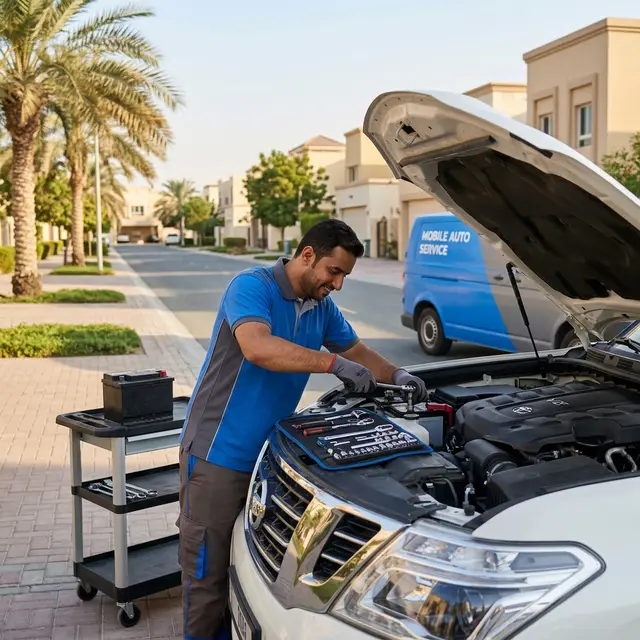
When we replace a battery, the old one leaves with the technician. It is carried upright in the service car and passed on for licensed recycling. You do not need to store it, transport it or find a drop-off point.
If you already have an old battery at home from an earlier replacement, mention it when you book. Keep it upright, outdoors in the shade and away from anything metal until it is collected.
Related pages
- Car battery replacement in Dubai
- Car battery replacement in Sharjah
- Car battery change by brand
- Car Battery Replacement Cost in Dubai: What Drives the Quote
- Range Rover Velar Battery Replacement: What Owners Should Know
- Range Rover "Low Battery Please Start Engine": What It Means and What to Do
- AGM vs EFB vs Flooded Car Batteries: Which One Does Your Car Need?