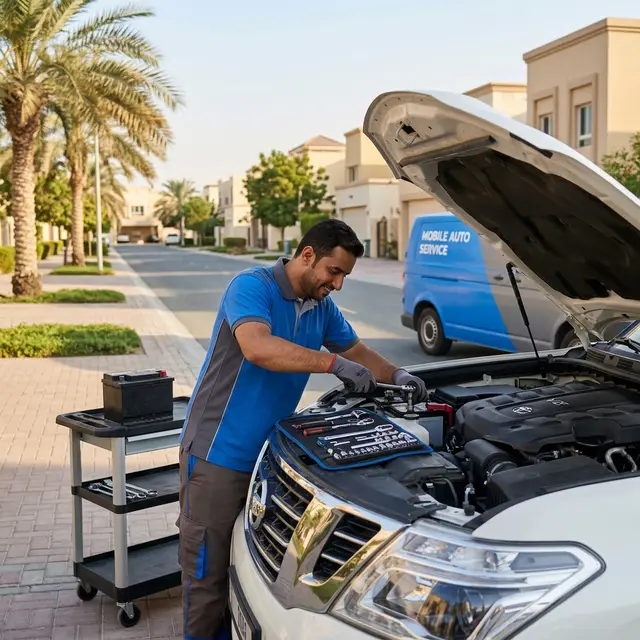
Call a mobile battery technician, not a recovery truck. Most recovery trucks are too tall for a basement entrance, while a technician arrives in a normal service car, drives down to your bay and jump starts or replaces the battery there. Tell building security a technician is coming and send the building name, basement level and bay number.
First steps at the car
Confirm it is the battery before you call. Dim or dead dash lights, a rapid clicking when you press start, or a key fob that will not unlock the doors all point to a flat battery. If the dash is bright and the engine cranks strongly without firing, the fault is elsewhere.
- Switch everything off and stop trying to start. Repeated attempts drain what little charge is left.
- If the car is locked and the fob is dead, use the mechanical key blade hidden inside the fob.
- Note the basement level, the bay number and the nearest lift lobby or pillar marking.
- Walk up to where your phone has signal and send your location and those details on WhatsApp.
- Tell security or the concierge that a battery technician is on the way.
Why a recovery truck is the wrong first call
Height is the problem. Basement entrances in towers and malls have a clearance bar, often a little over two metres, and a flatbed recovery truck does not fit under it. The truck ends up waiting at street level while the car sits two floors down.
A battery technician arrives in an ordinary service car that fits under the same bar as yours. The tools, a jump pack and the replacement battery come down with it, and the car is fixed in its own bay. For a flat battery this is quicker than any tow.
A dead car often cannot be moved
Modern cars lock themselves in place when the battery dies. The electronic parking brake stays clamped, and the gear selector stays in Park, because both need 12V power to release. Pushing the car out of the bay is not an option.
This applies to Range Rovers and most cars with a rotary or electronic shifter. Manual release procedures exist for some models and are described in the owner's handbook, but they are awkward and not something to attempt in a tight bay. Restoring power is the simpler way to get the car moving.
Getting the technician into the building
Access causes more delay than the repair. Residential towers, office buildings and malls each have their own rules, and a two-minute conversation with security saves a twenty-minute wait at the barrier.
- Residential towers: ask security to let the service car into the resident levels, or meet the technician at the gate with your access card.
- Visitor parking: if the service car has to use it, say which level connects to yours, as some visitor levels are separated from resident levels.
- Malls: give the car park zone and the colour or letter code on the pillar, plus the entrance you came in by.
- Office buildings: check whether the technician needs to register at reception, especially after hours.
- Keep your phone with you and stay somewhere with signal until the technician calls from the entrance.
What happens at the bay
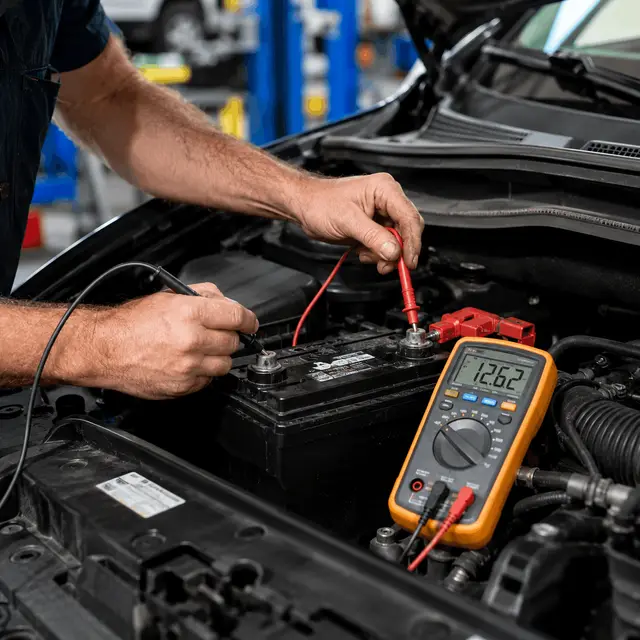
The technician tests the battery first. If it is healthy but discharged, a jump start gets you moving, and you will be told to drive for at least 30 minutes to recharge it. If it has failed, the correct replacement is fitted in the bay and the Battery Monitoring System is reset on cars that need it.
Tight bays are routine. The work needs the bonnet or boot open and space for one person, not a clear lane on both sides. The old battery leaves with the technician, so nothing is left behind in the car park.
Related pages
- Car Jump Start Service
- Car battery replacement in Dubai
- Car Recovery
- Car battery replacement service areas
- Range Rover Velar Battery Replacement: What Owners Should Know
- Range Rover "Low Battery Please Start Engine": What It Means and What to Do
- AGM vs EFB vs Flooded Car Batteries: Which One Does Your Car Need?